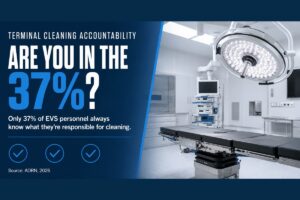
ATP testing in healthcare cleaning is a process used to measure whether surfaces were actually cleaned effectively by detecting leftover organic contamination that cannot always be seen with the naked eye.
In ambulatory surgery centers and healthcare facilities, ATP testing helps verify cleaning quality by using a swab and handheld meter to measure contamination levels on surfaces after cleaning.
A room can look spotless and still contain harmful contaminants. That’s why more healthcare facilities are using ATP testing as part of their cleaning quality assurance process.
Instead of relying on appearance alone, ATP testing provides measurable feedback about how well surfaces were cleaned.
For surgery centers, this matters because patient safety, inspection readiness, and infection prevention all depend on consistency.
What Does ATP Stand For?
ATP stands for Adenosine Triphosphate and is found in all living organic matter, including:
- Bacteria
- Bodily fluids
- Food residue
- Skin cells
- Organic contamination
If ATP is present on a surface after cleaning, it indicates that organic material may still remain.
In healthcare environments, that is a major concern.
How ATP Testing Works
ATP testing uses a handheld monitoring device and a specialized swab.
The process is simple:
- A surface is swabbed after cleaning
- The swab is inserted into the ATP meter
- The device measures contamination levels in seconds
- A numerical reading is produced
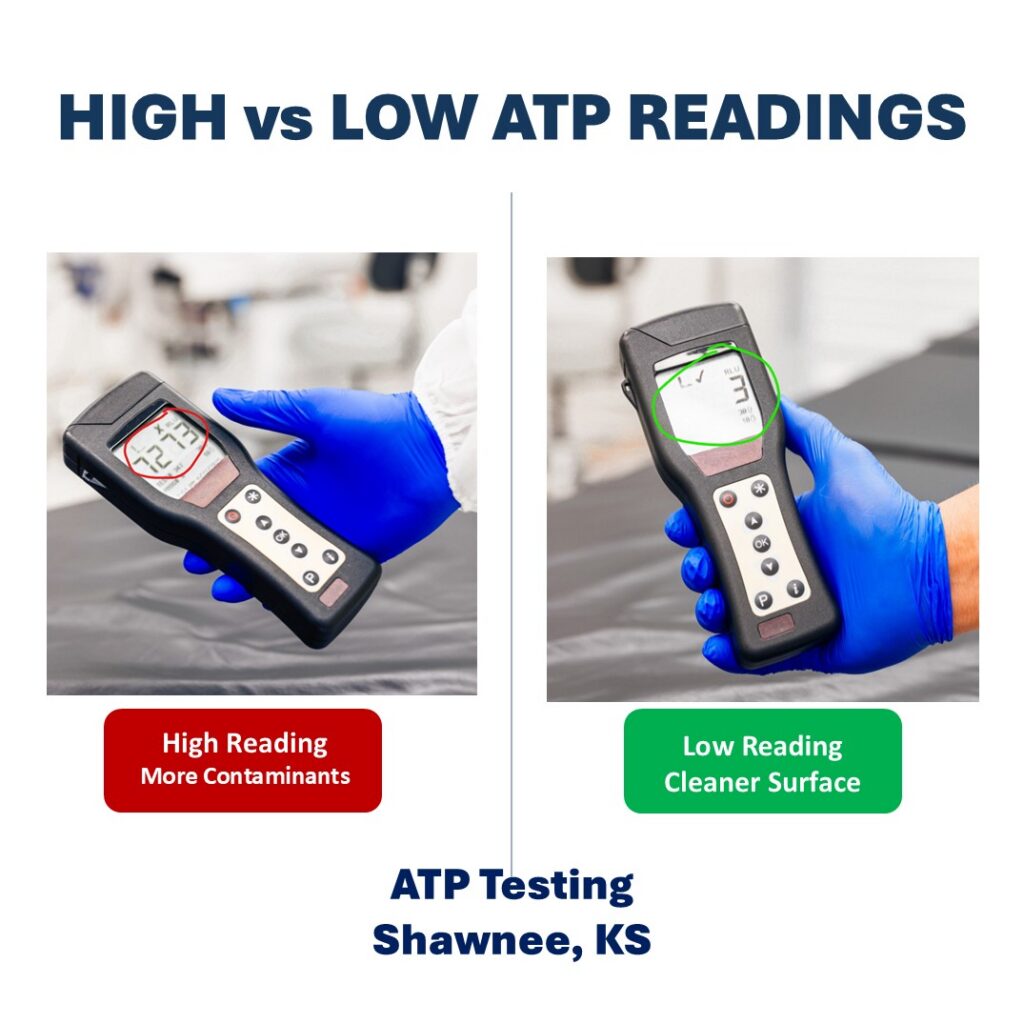
The lower the reading, the cleaner the surface.
Higher readings indicate more residual contamination.

ATP Testing Does NOT Detect Specific Viruses or Diseases
This is important to understand.
ATP testing is not designed to diagnose illness or identify specific pathogens like MRSA, COVID-19, or influenza.
Instead, ATP testing measures the presence of contaminants left behind on surfaces.
Think of it this way:
ATP testing verifies whether the cleaning process removed contamination effectively.
It is a cleaning validation tool – not a medical diagnostic tool.
Why ATP Testing Matters In Surgery Centers
In ambulatory surgery centers, consistency matters more than appearance.
Without validation, cleaning often becomes subjective:
- “It looks clean”
- “It smells clean”
- “The room was wiped down”
The problem is that visual inspections alone cannot confirm whether contamination was actually removed.
ATP testing helps provide measurable verification.
That matters because:
- High-touch surfaces are easily missed
- Inconsistent cleaning creates inspection risk
- Contaminants can reduce disinfectant effectiveness
- Small process failures compound over time
ATP testing helps remove guesswork from the process.
What Surfaces Are Commonly ATP Tested?
Healthcare facilities often ATP test high-touch areas such as:
- OR tables
- Mayo stands
- Light handles
- Door handles
- Anesthesia carts
- Touchscreens
- Counters
- Equipment surfaces
- Nursing stations
Understanding ATP Readings: Low vs High
ATP readings vary based on the device and the facility’s internal standards.
But generally:
Lower ATP readings usually indicate:
- Better removal of organic contamination
- More effective cleaning practices
- Better process consistency
Higher ATP readings may indicate:
- Missed contamination
- Incomplete cleaning
- Poor wiping technique
- Cross-contamination
- Inconsistent procedures
The goal is not perfection.
The goal is consistency and measurable improvement.
 ATP Testing Supports Accountability
One of the biggest advantages of ATP testing is accountability.
Instead of relying on assumptions, facilities can verify outcomes objectively.
This helps:
- Identify training gaps
- Improve cleaning consistency
- Validate terminal cleaning procedures
- Reinforce staff accountability
- Support inspection readiness
For healthcare leaders, ATP testing creates documentation that supports a stronger overall infection prevention program.
ATP Testing Should Support A System – Not Replace One
ATP testing alone does not create a clean environment.
It only verifies the effectiveness of the cleaning process already in place.
That means ATP testing works best when combined with:
- Defined cleaning protocols
- Proper disinfectant dwell times
- Staff training
- Structured terminal cleaning systems
- Consistent documentation
- Routine quality inspections
Without a defined process, ATP testing simply exposes inconsistency.
Common Misconception: “If ATP Is Low, We’re Safe.”
Low ATP readings are helpful, but they are not the entire picture.
A facility still needs:
- Proper disinfectants
- Correct procedures
- Trained staff
- Compliance with CDC and AORN-based cleaning practices
- Ongoing oversight
ATP testing is one piece of a larger infection prevention strategy.
Final thoughts
Healthcare cleaning should never rely on appearances alone.
In surgery centers, the real question is not: “Does the room look clean?”
The real question is: “Can the cleaning process be verified?”
That is why ATP testing has become an important part of modern healthcare environmental cleaning programs.
ATP testing provides measurable feedback, supports accountability, and helps healthcare facilities improve consistency where it matters most.
FAQs
Is ATP testing required in healthcare facilities?
ATP testing is not universally required by regulation, but many healthcare facilities use it as part of their quality assurance and infection prevention programs.
What do high ATP readings mean?
Higher ATP readings may indicate that organic contamination was left behind after cleaning. This can point to missed areas, inconsistent wiping practices, or process gaps that need attention.
Does ATP testing replace terminal cleaning?
No. ATP testing is simply a validation tool used to measure cleaning effectiveness. Proper terminal cleaning procedures, staff training, disinfectant dwell times, and consistent protocols are still essential.