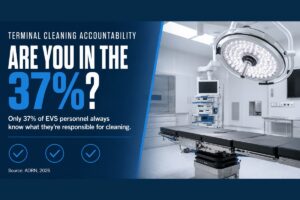
An ASC should monitor the quality of contracted cleaning. But when nurses must repeatedly chase missing records, investigate missed work, or supervise the contractor’s crew, the provider’s quality-control process needs attention.
A structured audit helps you verify performance, track recurring problems, and hold the contractor accountable for corrective action.
Step 1 – Audit the System Before You Audit the Room
Start with the provider’s operating system: facility-specific scope, responsibility matrix, SOPs, training, product procedures, backup coverage, checklists, supervisor process, and escalation path. If those elements are vague, inconsistent field results should not be surprising.
Step 2 – Sample, Do Not Reclean
Create a periodic audit schedule based on the facility’s risk assessment and policies. Sample selected rooms, surfaces, records, and shifts. The purpose is to test whether the contractor’s system works – not to repeat the entire cleaning process every day.
Step 3 – Score Safety, Performance, and Reliability
Use this suggested scale to rate each category separately, based on the observations and records reviewed:
1 — Poor: Major gaps; work or records cannot be relied on.
2 — Needs improvement: Frequent misses or repeated follow-up needed.
3 — Meets expectations: Requirements generally met; occasional gaps need correction.
4 — Strong: Consistent work, clear records, and prompt correction of gaps.
5 — Excellent: Consistent, documented performance with proactive follow-up and evidence that corrections last.
A serious concern in any category needs attention regardless of the other scores.
| Category | What to Sample | Evidence | Score |
| Safety | Visible soil response, product use, role boundaries, PPE/escalation | Observation + staff explanation | 1–5 |
| Performance | Assigned surfaces, complete floor scope, logs, exceptions | Observation + records | 1–5 |
| Reliability | Coverage, supervisor follow-up, communication, repeat issues | Staffing + QA + corrective action | 1–5 |
Step 4 – Use Objective Monitoring Where It Fits Your Program
CDC provides resources for evaluating environmental cleaning, including terminal-cleaning checklists and worksheets that support objective monitoring. Those resources are hospital-focused, not a blanket ASC regulatory requirement, but the quality principle is useful: use a defined, objective monitoring method where appropriate instead of relying only on random complaints or whether a room “looks clean.”
Depending on the facility, objective tools may include structured visual audits, fluorescent-marker programs, ATP testing used as a process indicator, or other validated approaches selected by infection-prevention leadership. The tool should match the question being asked; no single method proves sterility or infection prevention by itself.
Step 5 – Trend the Findings
One isolated miss and a repeating pattern are not the same management problem. Trend deficiencies by type, location, technician, shift, and corrective action. If the same issue returns, require the provider to address root cause instead of simply wiping the surface again.
Step 6 – Make the Contractor Own Improvement
A strong provider should investigate, retrain, adjust the checklist or staffing plan, verify the change, and report back. Your clinical team should not have to write the contractor’s improvement plan. That is the difference between purchasing cleaning labor and purchasing a managed cleaning system.
Frequently Asked Questions
01. How often should an ASC audit its cleaning contractor?
Set an audit schedule based on your facility’s policies, risk assessment, and the contractor’s performance. Review a sample of rooms, cleaning records, and shifts. Repeated deficiencies or staffing changes may call for closer follow-up. The contractor should also have its own process for supervising and checking the work between your audits.
02. What documentation should an ASC request from its cleaning contractor?
Ask for facility-specific cleaning procedures, completed cleaning logs, staff training records, inspection results, and corrective-action records. Also review the backup staffing and escalation plans. Together, these should help you understand what was done, who checked it, and how problems were handled.
03. What should happen when the same cleaning problem keeps coming back?
The contractor should investigate the cause and explain what will change, such as training, staffing, supplies, or the checklist. Ask who is responsible, when the change will be completed, and how improvement will be verified. Keep a record of repeat findings so you can assess whether the solution is working.

Request Your Complimentary Surgical Cleaning Assessment
Prefer to talk? Call 913-427-6100 to discuss your ASC’s cleaning needs.